GPON Link Budget Calculation: Complete Guide (ITU-T G.984)
Total Loss = fiber + splices + connectors + splitters + aging margin. Compare it against your optical class budget (Class B+ = 28 dB). Omit any single term and a design that "passes" on paper fails in the field.
Why generic Excel templates fail mid-design
During seven years deploying FTTH in Venezuela, I saw the same failure pattern repeatedly: a design passes initial validation, then OTDR traces after installation show unexpected attenuation near closure points. The root cause was almost always the spreadsheet, not the fiber.
- Rounded constants. Templates hardcode one attenuation value and ignore that fiber coefficients differ by fiber type and wavelength band.
- Omitted loss terms. Splitter excess loss and connector pair loss get "simplified" away, biasing every downstream result.
- No aging floor. The 3 dB reserve mandated for a 20-year lifetime is treated as optional, so margins look healthy on day one and degrade below spec by year five.
The five-component formula
Total Loss = L_fiber + L_splice + L_connector + L_splitter + L_aging| Component | How it is computed | Values used by our engine |
|---|---|---|
| Fiber | Distance × attenuation coefficient | 0.35 / 0.33 / 0.30 dB/km (G.652.D / G.657.A1 / G.657.A2) |
| Mechanical splices | Count × per-splice loss | 0.1 dB each |
| Connectors | Count × per-pair loss | 0.3 dB per pair |
| Splitters | Count × planning average | 3.5 dB each (ratio-specific nominal loss — 1:2 = 3.5, 1:4 = 7.2, 1:8 = 10.5, 1:16 = 13.8, 1:32 = 17.1 dB — is modeled separately in cascade simulations) |
| Aging margin | Fixed reserve floor | ≥ 3 dB (ITU-T G.984, 20-year lifetime) |
| Class B+ budget | Reference ceiling | 28 dB |
Worked example: 15 km route, single 1:8 split
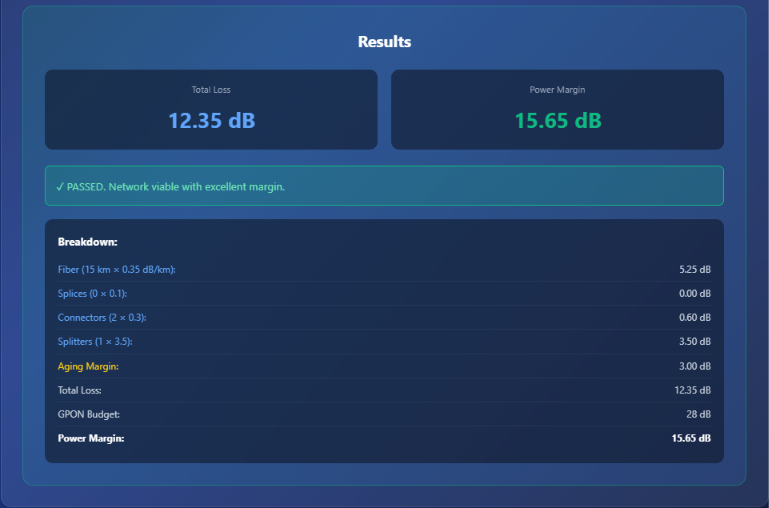
Inputs: 15 km of G.652.D fiber, 0 mechanical splices, 2 connector pairs, 1 splitter, 3 dB aging margin.
- Fiber: 15 km × 0.35 dB/km = 5.25 dB
- Splices: 0 × 0.1 = 0.00 dB
- Connectors: 2 × 0.3 = 0.60 dB
- Splitter: 1 × 3.5 = 3.50 dB
- Aging: 3.00 dB
Total Loss = 12.35 dB. Power Margin = 28 − 12.35 = 15.65 dB. Verdict: PASS with excellent margin. Our thresholds: margin ≥ 3 dB passes, 1–3 dB requires optimization, below 1 dB requires redesign.
Validate this in seconds, offline
The free GPON Link Budget Calculator applies exactly these constants. No spreadsheet, no internet needed in the field.
Download the free calculatorThree costly mistakes to avoid
- Designing to the edge of the budget. A margin of exactly 3 dB leaves zero room for repair splices added later.
- Counting connectors as single points. Loss applies per mated pair; counting halves understates loss by 0.3 dB per connection.
- Reusing urban templates for rural routes. Long reaches amplify any coefficient error linearly with distance.
Edge cases where manual math breaks down
- Multi-stage unbalanced cascades, where each stage has a different split ratio.
- Routes mixing fiber types (aerial G.652.D plus bend-insensitive G.657 drop sections).
- Remote node powering, where voltage drop constraints change cabinet placement and therefore fiber distance.
These are exactly the cases the full Suite Pro automates across its five modules.
FAQ
What aging margin should I use for GPON?
ITU-T G.984 recommends a minimum 3 dB reserve for a 20-year network lifetime. Treat it as a fixed floor, not an optional checkbox.
Why does my spreadsheet disagree with professional tools?
Generic templates round constants, omit splitter excess loss, or skip the aging margin. Small omissions compound into field failures.
Can I validate link budgets offline in the field?
Yes. The free Apex GPON Link Budget Calculator runs fully offline after one-time activation, so site surveys never depend on connectivity.